
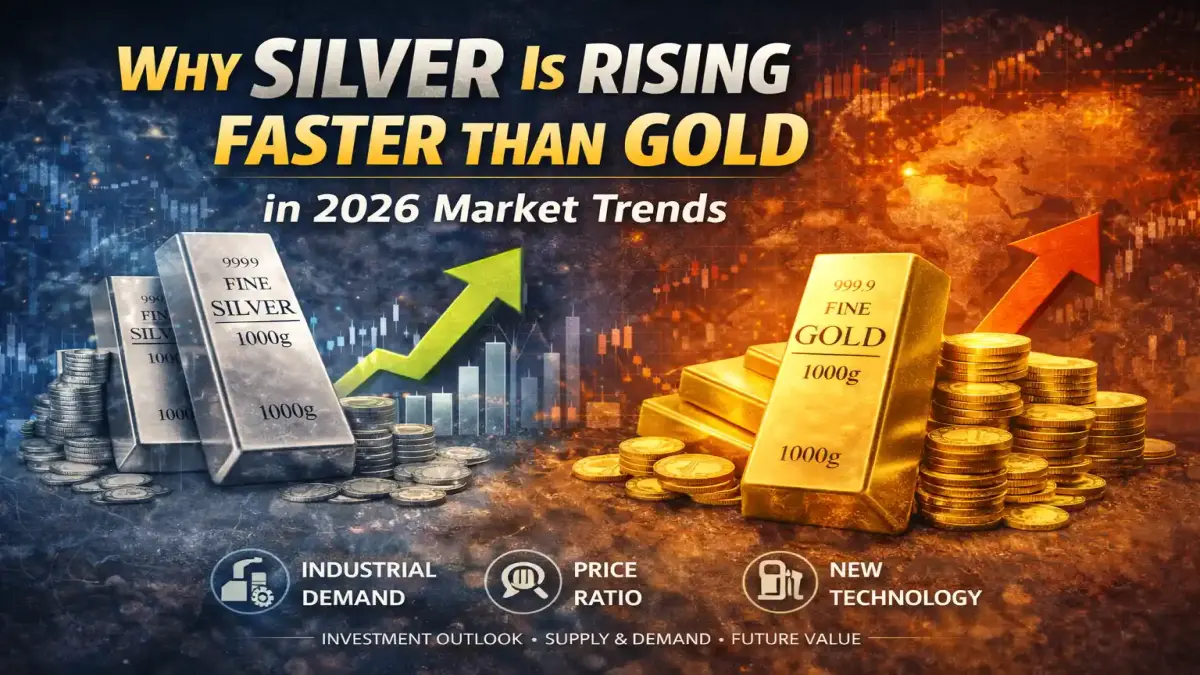
Why Silver Is Rising Faster Than Gold in 2026 Market Trends
Table of Contents
Why Silver Is Rising Faster Than Gold in 2026 Market Trends
Why Is Silver Outperforming Gold in 2026?
Silver is rising faster than gold due to strong industrial demand, renewable energy growth, and its higher price volatility compared to gold.
In 2026, the global precious metals market is witnessing a noticeable shift. While gold continues to hold its position as a safe-haven asset, silver is gaining significant momentum and, in many cases, outperforming gold in terms of price growth. This trend has caught the attention of investors, analysts, and financial experts worldwide.
Understanding why silver is rising faster than gold requires a deep analysis of market dynamics, industrial demand, economic conditions, and investor behavior. Unlike gold, which is primarily driven by macroeconomic factors, silver has a dual role as both an investment asset and an industrial metal. This unique characteristic gives silver an edge in certain market conditions.
The Dual Nature of Silver
Silver’s value comes from two major sources: investment demand and industrial usage. This dual nature makes it more dynamic compared to gold. During economic growth, industrial demand increases, pushing silver prices higher. At the same time, silver also benefits from investment demand during uncertain periods.
In 2026, industries such as renewable energy, electronics, and electric vehicles are expanding rapidly. These sectors rely heavily on silver, creating strong demand and supporting price growth.
Industrial Demand Driving Silver Prices
One of the biggest reasons for silver’s rapid rise is its increasing industrial demand. Silver is widely used in solar panels, electronics, batteries, and various high-tech applications. As the world moves towards cleaner energy and advanced technology, the demand for silver continues to grow.
The renewable energy sector, in particular, has become a major driver of silver demand. Solar panel production requires significant amounts of silver, and as countries invest in sustainable energy, this demand is expected to increase further.
Higher Volatility Means Higher Growth Potential
Silver is more volatile than gold, meaning its prices can move more sharply in both directions. While this increases risk, it also creates opportunities for higher returns. In bullish market conditions, silver often outperforms gold due to this volatility.
Investors looking for growth opportunities are increasingly turning to silver, contributing to its rising prices.
Gold’s Stability vs Silver’s Growth
Gold is known for its stability and safe-haven appeal. It performs well during economic uncertainty but tends to grow at a slower pace compared to silver during periods of economic expansion.
In 2026, while gold remains strong, its growth is relatively stable. Silver, on the other hand, benefits from both economic recovery and industrial demand, leading to faster price increases.
Supply Constraints in Silver Market
Silver supply is limited and often tied to the production of other metals such as copper and zinc. This means that even if demand increases, supply may not be able to keep up quickly.
In 2026, supply constraints have become more noticeable, adding upward pressure on silver prices.
Investment Demand Surge
Apart from industrial demand, silver is also gaining popularity among investors. As awareness grows about its potential for higher returns, more investors are including silver in their portfolios.
This increased investment demand further supports price growth.
Impact of Inflation
Inflation affects both gold and silver, but silver’s industrial demand gives it an additional advantage. As inflation rises, investors look for assets that can preserve value, boosting demand for both metals.
However, silver’s dual role allows it to benefit from both inflation and industrial growth.
Technological Advancements
Technological advancements are increasing the demand for silver in various industries. From smartphones to electric vehicles, silver plays a crucial role in modern technology.
As technology continues to evolve, the demand for silver is expected to grow, supporting long-term price increases.
Short-Term vs Long-Term Trends
In the short term, silver may experience higher volatility due to market fluctuations. However, in the long term, its strong demand fundamentals make it a promising investment.
Gold, while stable, may not match silver’s growth rate during periods of economic expansion.
Comparison Between Gold and Silver in 2026
- Gold: Stable, low volatility, safe-haven asset
- Silver: High growth potential, higher volatility
- Gold: Driven by economic uncertainty
- Silver: Driven by industrial and investment demand
Risks to Consider
- Market volatility
- Economic slowdown reducing industrial demand
- Supply chain disruptions
Investment Strategy for 2026
Diversification
Combining gold and silver in a portfolio can provide both stability and growth.
Long-Term Approach
Holding silver for the long term allows investors to benefit from its growth potential.
Regular Monitoring
Keeping track of market trends helps in making informed investment decisions.
Future Outlook
The future of silver looks promising due to increasing industrial demand and technological advancements. While gold will continue to provide stability, silver is likely to offer higher growth potential in the coming years.
Investors who understand these trends can position themselves to benefit from silver’s rise.
Conclusion
Silver is rising faster than gold in 2026 due to its unique combination of industrial demand and investment appeal. While gold remains a stable asset, silver offers higher growth potential, making it an attractive option for investors.
A balanced approach that includes both metals can help investors achieve financial stability and growth in an uncertain market environment.






0 Comments