
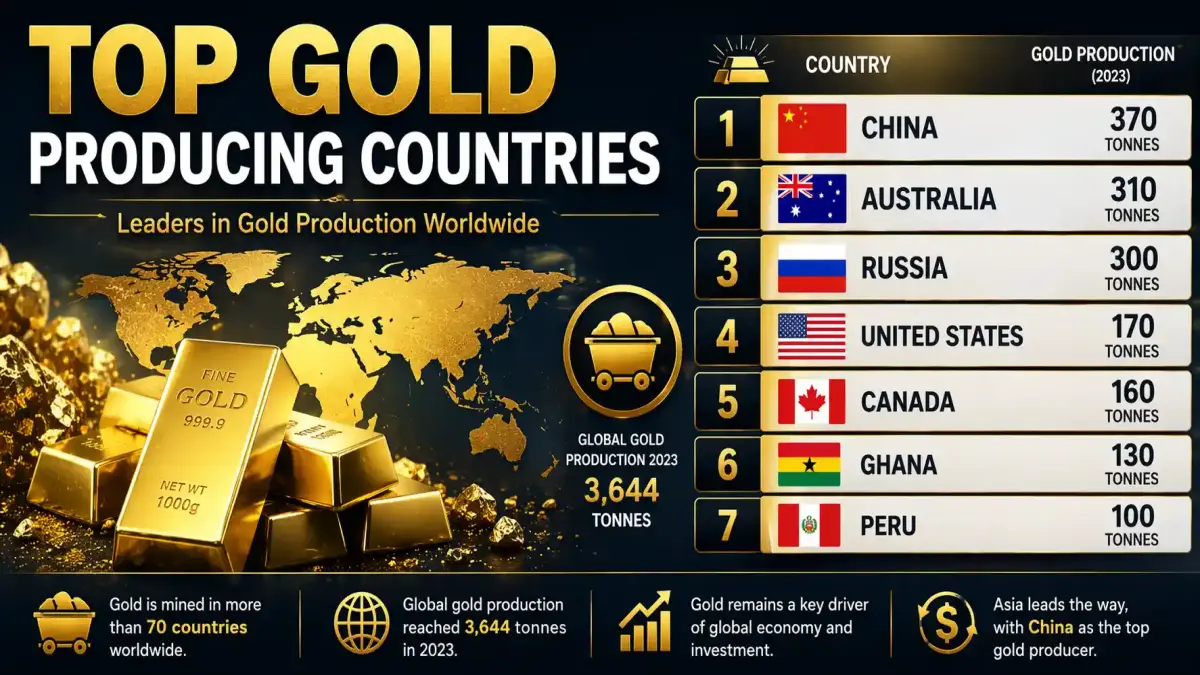
Top Gold Producing Countries
Table of Contents
Top Gold Producing Countries: A Complete Guide to Global Gold Mining and Supply
Gold has fascinated humanity for thousands of years, not only because of its beauty but also because of its ability to preserve value across generations. Even in today’s digital financial world, gold remains one of the most trusted and widely used assets. While investors often focus on gold prices and investment strategies, one of the most important aspects that directly influences the gold market is production. Understanding which countries produce gold and how production works provides deep insight into supply, pricing, and long-term trends.
Gold production is a complex process that involves exploration, extraction, refining, and distribution. It requires significant investment, advanced technology, and strong infrastructure. Only a few countries have the natural resources and capabilities required to produce gold on a large scale. These countries play a crucial role in maintaining the global gold supply and influencing price movements.
In this detailed guide, we will explore the top gold producing countries, understand how gold is mined, analyze the factors that influence production, and explain how production affects global markets and investment decisions. This is not just a list of countries but a complete explanation designed to help you understand the gold industry from a practical and investor-focused perspective.
Understanding Gold Production and Why It Matters
Gold production refers to the process of extracting gold from the earth and converting it into usable forms such as bars, coins, or industrial materials. Unlike many other commodities, gold production grows slowly because mining is a difficult and time-consuming activity. This limited growth in supply is one of the main reasons why gold retains its value over time.
For investors, gold production is extremely important because it directly affects supply levels. When production increases significantly, it can help stabilize prices. However, if production declines due to operational challenges or regulatory restrictions, prices may rise due to limited supply. This relationship between supply and demand is fundamental to understanding the gold market.
Another important aspect is that gold, once mined, does not get consumed in the same way as other commodities like oil. Most of the gold ever mined still exists in some form, whether as jewelry, investment assets, or central bank reserves. This makes gold supply unique, as both new production and existing stock influence the market.
How Gold is Mined: A Simplified Explanation
The process of gold mining begins with exploration. Mining companies invest heavily in identifying areas that contain gold deposits. Once a viable deposit is found, extraction begins through methods such as open-pit mining or underground mining.
After extraction, the raw ore is processed to separate gold from other materials. This involves crushing, chemical treatment, and refining. The final product is pure gold, which is then shaped into bars or other forms for distribution.
This entire process is expensive and requires skilled labor, advanced machinery, and strict safety measures. As a result, only countries with strong economic and technological capabilities can sustain large-scale gold production.
Top Gold Producing Countries in the World
China: The Global Leader
China is the largest gold producer in the world, consistently maintaining its top position for many years. The country has heavily invested in mining infrastructure and technology, allowing it to extract gold efficiently from its reserves.
One of the unique aspects of China’s gold industry is that most of its production is consumed domestically. The country has a strong demand for gold in both jewelry and investment sectors, which reduces its reliance on exports.
China’s dominance in production gives it significant influence over global supply and pricing trends.
Australia: Resource-Rich and Export-Oriented
Australia is known for its vast natural resources and advanced mining industry. The country produces a large amount of gold and exports a significant portion to global markets.
Australian gold mining is highly efficient due to the use of modern technology and strong regulatory frameworks. This ensures consistent production and high-quality output.
Gold exports are a major contributor to Australia’s economy, making it one of the most important players in the global gold trade.
Russia: Strategic Gold Production
Russia is another major gold producer with extensive reserves and growing production capacity. The government actively supports the mining sector and uses gold as part of its financial strategy.
In addition to exporting gold, Russia also accumulates it as part of its national reserves. This dual approach strengthens its economic position and reduces dependence on foreign currencies.
United States: Technological Strength
The United States has a well-developed gold mining industry, with significant production coming from regions like Nevada. Advanced technology and efficient mining operations allow the country to maintain steady output.
Although the US produces a substantial amount of gold, it still imports gold to meet its domestic demand, highlighting the complexity of global trade.
Canada: High Standards and Growth Potential
Canada is known for its high-quality mining operations and strong environmental regulations. The country continues to invest in exploration and new mining projects, ensuring long-term growth.
Canadian gold is widely exported, contributing to global supply and supporting economic development.
South Africa: Historical Significance
South Africa was once the world’s leading gold producer and played a major role in shaping the global gold industry. Although production has declined over time, the country still remains an important contributor.
The decline is mainly due to aging mines and increasing extraction costs, but South Africa’s legacy in gold mining continues to influence the industry.
Other Important Gold Producing Countries
In addition to the major producers, several other countries contribute significantly to global gold supply. These include Peru, Indonesia, Ghana, and Mexico. While their production levels may not match the top producers, they play an important role in maintaining supply stability.
These countries often rely on gold mining as a major source of economic growth and employment, making the industry crucial for their development.
Factors That Influence Gold Production
Gold production is influenced by multiple factors, including geological availability, technology, government policies, and economic conditions. Countries with rich deposits have a natural advantage, but they must also invest in infrastructure and skilled labor to extract gold efficiently.
Government policies play a significant role. Supportive regulations encourage mining activities, while strict rules or political instability can limit production. Environmental concerns are also becoming increasingly important, requiring companies to adopt sustainable practices.
Challenges in Gold Mining
Gold mining is not without challenges. As easily accessible deposits are depleted, companies must dig deeper and invest more resources to extract gold. This increases costs and reduces profitability.
Environmental regulations also add complexity, as companies must minimize their impact on ecosystems. Additionally, fluctuating gold prices can affect investment decisions and production levels.
How Gold Production Affects Prices
Gold prices are determined by the balance between supply and demand. When production increases, supply improves, which can stabilize prices. However, if demand rises faster than supply, prices may still increase.
On the other hand, a decline in production can lead to supply shortages, pushing prices higher. This makes production trends an important indicator for investors.
Future of Gold Production
The future of gold production will depend on technological advancements, exploration efforts, and sustainability initiatives. New technologies are making mining more efficient, while exploration projects aim to discover new reserves.
At the same time, the industry is focusing on reducing environmental impact and improving sustainability. These changes will shape the future of gold production and influence global supply patterns.
Why This Matters for Investors
Understanding gold production helps investors make better decisions. By analyzing which countries are increasing or decreasing production, investors can predict potential price movements.
Production trends also reflect economic and political conditions, providing insights into market stability and risk factors.
Conclusion
The top gold producing countries play a vital role in shaping the global gold market. From China’s leadership to Australia’s exports and Russia’s strategic reserves, each country contributes to global supply in unique ways.
Gold remains a valuable asset due to its limited supply and consistent demand. By understanding production trends and global dynamics, investors can make informed decisions and build stronger financial strategies for the future.






0 Comments