
The Complete Compendium of Metals | History, Science, Markets & Future Trends
Table of Contents
Metals Unearthed: A 360° Journey Through History, Science, Global Markets & The Green Revolution
Metals are not merely elements on the periodic table — they are the architectural skeleton of civilization. Whether it’s the golden death mask of Tutankhamun, the steel girders of the Brooklyn Bridge, or the neodymium magnets inside a wind turbine, metals encapsulate human progress. Today, global metal markets are surging due to geopolitical shifts, energy transition, and technological breakthroughs. Understanding metals is no longer just for geologists; it’s essential for investors, engineers, and conscious citizens.
🔬 What Defines a Metal? (The Science Beneath the Shine)
Metals form a class of chemical elements distinguished by their unique atomic structure — a lattice of positive ions immersed in a "sea" of delocalized electrons. This electron mobility gives metals their hallmark properties: thermal and electrical conductivity, malleability, ductility, metallic luster, and high tensile strength. About 75% of the periodic table consists of metals, yet only a handful dominate global industry.
Metals occur naturally in the Earth’s crust, typically as ores combined with oxygen, sulfur, or silicates. Extractive metallurgy — the art of separating pure metal from gangue — has evolved from primitive fire-setting to bioleaching and electrolytic refining. Modern society consumes over 2 billion metric tons of steel annually, alongside millions of tons of copper, aluminum, and specialty metals.
📜 The Epic History: How Metals Forged Human Destiny
The chronology of civilization is etched in metal. Before metallurgy, our ancestors used native copper and meteoric iron as curiosities. The true revolution began around 5000 BCE with the discovery of smelting — transforming ores into pure metal using heat.
✨ The Copper & Bronze Age (4500–1200 BCE)
Copper was the first metal intentionally alloyed. When artisans discovered that adding tin to copper produced bronze — a harder, more durable material — empires rose. The Bronze Age saw the emergence of trade networks stretching from Cornwall (tin) to the Middle East, fueling advanced weaponry, chariots, and monumental art. Bronze metallurgy elevated urban centers like Mesopotamia, the Indus Valley, and ancient China.
⚙️ The Iron Age (1200 BCE–1 CE)
Iron smelting marked a seismic shift. Unlike copper and tin, iron ore was abundant, and with carburization techniques, early blacksmiths created steel that outperformed bronze. The Hittites pioneered ironworking, but it was the widespread adoption that democratized tools and weapons. Iron plows transformed agriculture, while steel swords redrew borders. The Iron Age catalyzed classical empires — Rome, Persia, and Han China — enabling aqueducts, armor, and infrastructure at unprecedented scale.
🏭 Industrial Revolution & Modern Era
The 18th century brought coke-smelted iron and the Bessemer process, making steel cheap and plentiful. Railroads, skyscrapers, and the automotive industry became possible. The 20th century introduced aluminum (lightweight, corrosion-resistant) and specialty alloys for aerospace. Today, we witness the rare earth revolution — 17 elements essential for smartphones, EV motors, guided missiles, and MRI machines.
🧲 The Complete Taxonomy of Metals (With Real-World Uses)
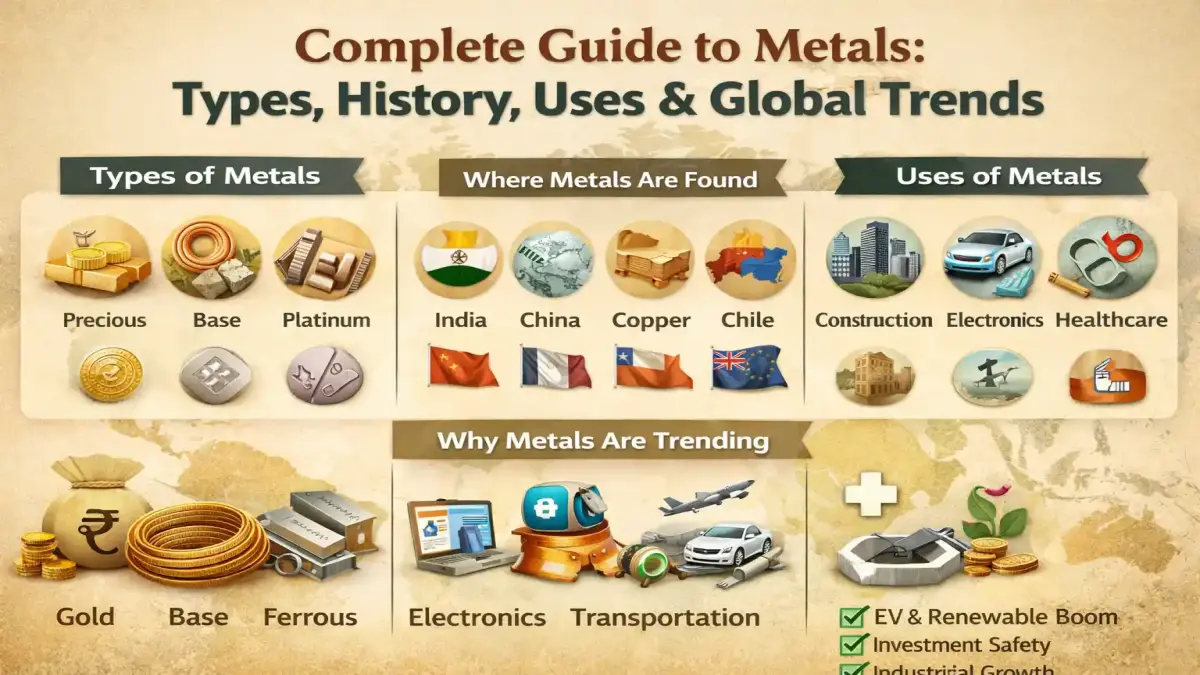
Metals are categorized by composition, rarity, and behavior. Below is a detailed breakdown of each family, plus their industrial & economic roles.
1️⃣ Precious Metals: Timeless Store of Value
Gold (Au): The ultimate monetary metal. Beyond jewelry, gold is critical in aerospace (radiation shielding), high-end electronics, and medical implants due to inertness. Central banks hold over 35,000 metric tons as reserves.
Silver (Ag): The industrial precious metal. Silver’s unmatched conductivity makes it vital for solar panels (photovoltaic cells), EVs, and 5G infrastructure. Silver demand is forecasted to outstrip supply by 2027.
Platinum & Palladium: Key for catalytic converters that reduce vehicle emissions; also used in hydrogen fuel cells and anticancer drugs. South Africa and Russia dominate supply.
2️⃣ Base & Industrial Metals: Global Economy Backbone
Copper (Cu): "Dr. Copper" holds a PhD in economics because its demand correlates with GDP growth. Electric vehicles require 2.5x more copper than ICE cars. Chile produces ~27% of world supply.
Aluminum (Al): Lightweight, recyclable, and corrosion-resistant. From aircraft fuselages to smartphone bodies, aluminum’s versatility is unmatched. Production relies heavily on bauxite mining in Australia, Guinea, and China.
Zinc (Zn): Galvanizes steel to prevent rust — 50% of zinc consumption goes to construction & infrastructure.
Nickel (Ni): Critical for stainless steel and high-nickel EV battery cathodes (NMC 811). Indonesia is now the world’s nickel powerhouse.
3️⃣ Ferrous Metals: The Strength of Industry
Iron & Steel: More than 1.9 billion tons of crude steel produced yearly. Steel is the skeleton of cities — bridges, railways, shipping containers. Modern electric arc furnaces make steel production greener.
4️⃣ Rare Earth Elements (REE): Tech’s Secret Sauce
The 17 REEs are not "rare" in abundance but difficult to mine economically and refine. Neodymium creates the strongest permanent magnets (used in EV motors and wind turbines). Dysprosium adds heat resistance to magnets. Lanthanum is used in hybrid car batteries and camera lenses. China currently refines ~85% of global REE output, prompting western nations to diversify supply chains.
| Metal Category | Key Metals | Primary End-Uses (2026 Trends) |
|---|---|---|
| Precious | Gold, Silver, Platinum, Palladium | Green hydrogen catalysts, medical tech, investment reserves |
| Base/Industrial | Copper, Aluminum, Zinc, Nickel | EV wiring, renewable grid, energy storage, construction |
| Ferrous | Iron, Steel, Carbon steel | Infrastructure, heavy machinery, offshore wind platforms |
| Rare Earth | Neodymium, Praseodymium, Terbium | EV motors, wind turbines, drones, robotics |
🗺️ Global Metal Deposits: Who Mines What & Where
Geological luck and strategic investment define metal superpowers. China leads in rare earths, graphite, and refined copper. Australia is the top producer of iron ore, bauxite, and lithium. Chile reigns supreme in copper. The Democratic Republic of Congo supplies over 70% of the world’s cobalt — a key EV battery ingredient. Below are regional powerhouses:
- Gold: China, Russia, Australia, Canada, United States (Nevada’s Carlin Trend).
- Silver: Mexico, Peru, China — silver is often a byproduct of lead-zinc or copper mining.
- Copper: Chile (Escondida mine), Peru, DRC, United States.
- Lithium: The "white gold" triangle: Chile, Argentina, Bolivia plus Australia’s hard-rock spodumene.
- Rare Earths: China dominates processing; potential new mines in the US (Mountain Pass), Australia (Lynas), and Brazil.
- Iron Ore: Australia (Pilbara) and Brazil (Carajás) account for more than 60% of global seaborne trade.
Geopolitical tension, export restrictions, and critical mineral legislation (like the US Inflation Reduction Act) are reshaping supply chains. Near-shoring and recycling hubs are emerging as strategic priorities.
⚡ Why Metals Are Trending in 2026: The Energy Transition & Beyond
Five powerful drivers are pushing metals to the forefront of public consciousness and financial markets:
- Electric Vehicle (EV) Tsunami: EVs require 6x more mineral inputs than combustion cars. Lithium, nickel, cobalt, graphite, and copper demand will surge 400% by 2030 according to the IEA.
- Renewable Energy Systems: A single wind turbine contains ~3 tons of copper and significant rare earths. Solar parks depend on aluminum frames and silver paste.
- Defense & AI Infrastructure: Modern weapon systems and semiconductor fabs require gallium, germanium, and high-purity copper. Strategic stockpiling is expanding globally.
- Inflation Hedge & Safe Havens: Amid lingering inflation and currency volatility, retail and institutional investors are accumulating physical gold and silver ETFs. Central bank gold buying is at a decade high.
- Circular Economy & Urban Mining: Recycling metals from e-waste reduces environmental impact. The EU’s Critical Raw Materials Act mandates that at least 25% of strategic metals be recycled by 2030.
🏗️ Modern Applications: How Metals Shape Every Industry
Construction & Infrastructure: Structural steel, rebar, aluminum curtain walls, and zinc roofing dominate skylines. Smart cities leverage copper for high-speed data transmission.
Electronics & Semiconductors: Gold for corrosion-free connectors, tantalum for capacitors, tin for soldering. Without specialty metals, Moore’s Law would halt.
Healthcare: Titanium for prosthetics and implants (biocompatible), platinum in chemotherapy drugs, silver in antimicrobial wound dressings.
Transportation: High-strength steel for safety cages, aluminum for fuel efficiency in aerospace, magnesium alloys for lightweight EVs.
Energy Storage: Lithium-ion batteries dominate portable electronics and EVs; vanadium redox flow batteries gain ground for grid storage.
📊 Metal Investment Guide: Physical, Paper, or Equities?
Investing in metals offers diversification and inflation protection. Strategies vary by risk appetite:
- Physical Bullion: Gold bars, silver coins, platinum ingots — tangible, no counterparty risk. Storage and insurance costs apply.
- Exchange-Traded Funds (ETFs): GLD (gold), SLV (silver), COPX (copper miners) provide liquidity without physical handling.
- Mining Stocks & Royalties: Junior explorers offer high risk/reward; majors like BHP, Rio Tinto, Freeport-McMoRan provide dividends.
- Futures & Options: Sophisticated instruments for hedging or speculating on price movements.
- Digital Gold & Tokenized Metals: Blockchain-based fractional ownership is emerging among tech-savvy investors.
Expert tip: For 2026, analysts recommend a "barbell approach" — defensive gold alongside lithium/copper exposure to capitalize on electrification megatrends.
♻️ Sustainability & Challenges: The Dark Side of Metallurgy
Despite their utility, metal extraction carries environmental and social costs. Mining accounts for ~7% of global CO₂ emissions. Water-intensive processes, tailings dam failures, and deforestation in biodiverse regions remain critical issues. However, the industry is pivoting:
- Green Steel: Hydrogen-based direct reduction (HYBRIT) eliminates coal use, producing near-zero emission steel.
- Battery Recycling: Redwood Materials and other firms aim to close the loop for lithium-ion batteries, recovering 95% of metals.
- ESG Standards: London Metal Exchange (LME) now requires responsible sourcing protocols to avoid conflict minerals.
Consumers and governments demand transparency. The future of metals will be defined by circularity, renewable-powered smelting, and ethical supply chains.
🔭 Future Frontiers: Space Mining & Advanced Alloys
The next horizon lies beyond Earth: asteroids contain staggering amounts of platinum group metals and nickel-iron. While space mining is speculative, NASA’s Psyche mission is exploring a metal-rich asteroid. Closer to home, metallurgists are developing high-entropy alloys (HEAs) that withstand extreme temperatures — perfect for hypersonic travel and next-gen nuclear reactors. Additionally, "self-healing" metals and 3D-printed metal parts will revolutionize manufacturing.
❓ Frequently Asked Questions (FAQs)
Q1: What is the difference between ferrous and non-ferrous metals?
Ferrous metals contain iron, making them magnetic and prone to rust (e.g., steel, cast iron). Non-ferrous metals (aluminum, copper, brass) do not contain iron, offering higher corrosion resistance and conductivity.
Q2: Which metal will be most in demand by 2030?
Copper and lithium are poised for explosive growth due to the energy transition, followed by rare earths and nickel for EV batteries. Gold will remain a dominant store of value.
Q3: Is investing in silver better than gold?
Silver offers higher volatility with greater industrial upside, whereas gold is a traditional safe haven. A balanced portfolio often includes both depending on risk tolerance.
Q4: Are metals recyclable indefinitely?
Most metals, including steel, aluminum, and copper, can be recycled infinitely without losing their properties. Recycling uses up to 90% less energy than primary production.
Q5: What country produces the most rare earth metals?
China leads in mining and processing, accounting for about 60% of global mined output and 85% of refining capacity, though the US, Australia, and African nations are expanding production.
📌 Conclusion: Forging a Metal-Powered Tomorrow
From the Bronze Age swords that carved empires to the nickel cathodes driving electric fleets, metals remain humanity’s most faithful partners in progress. In 2026, we stand at a pivotal moment: the choices we make regarding extraction, innovation, and recycling will define the sustainability of our civilization. Whether you’re an investor eyeing copper futures, an engineer designing lighter structures, or a curious mind exploring the periodic table, metals are woven into your everyday reality. By understanding their types, histories, and global dynamics, we become better stewards of Earth’s mineral wealth and architects of a resilient future.
Stay curious, stay informed, and remember — the next breakthrough alloy, battery metal, or mining innovation could reshape the world once again, just as iron did three millennia ago.





0 Comments