
History of Gold Prices Worldwide
Table of Contents
History of Gold Prices Worldwide: Complete Timeline and Market Insights
What is the history of gold prices?
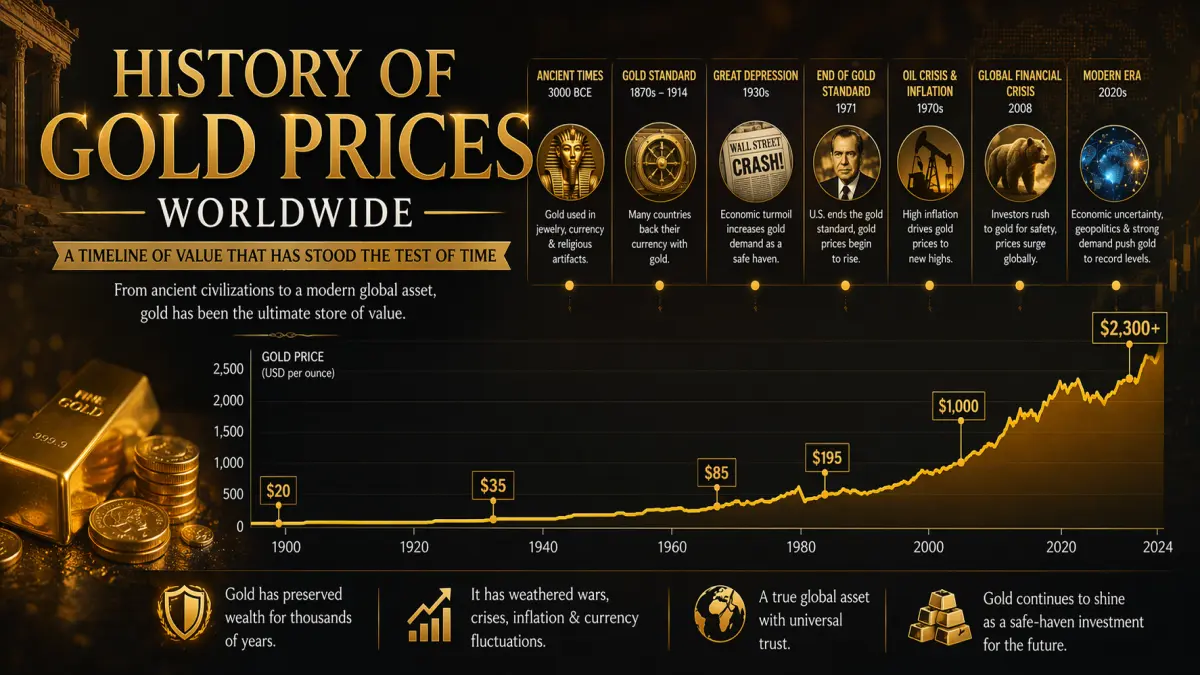
The history of gold prices reflects global economic changes, shifting from fixed values under the gold standard to market-driven pricing influenced by inflation, demand, and geopolitical events.
Gold has always held a unique place in human civilization, acting as a store of value, a symbol of wealth, and a reliable financial asset. Unlike modern currencies, gold has intrinsic value that does not depend on any government or institution. Because of this, gold has maintained its importance across centuries, evolving from a simple trade medium into a globally traded commodity. Understanding the history of gold prices worldwide provides valuable insight into how economic conditions, political decisions, and investor behavior shape its value over time.
In ancient times, gold did not have a fluctuating market price as we see today. Its value was relatively stable and often determined by rulers or empires. As trade expanded and economies developed, gold became a standard unit of exchange. Over time, its pricing system evolved alongside financial systems, eventually becoming a globally traded asset influenced by supply and demand.
Gold in Ancient and Medieval Economies
In early civilizations such as Egypt, Rome, and Mesopotamia, gold was used as currency and a measure of wealth. Coins made of gold were widely accepted, and their value was based on weight and purity. This system provided consistency and trust in trade.
During medieval times, gold continued to play a central role in trade and commerce. However, prices remained relatively stable because gold supply was limited and controlled by ruling authorities. The lack of modern financial systems meant that price fluctuations were minimal compared to today’s markets.
The Gold Standard Era
The gold standard marked a significant phase in the history of gold prices. Under this system, countries fixed their currency values to a specific amount of gold. This created stability in exchange rates and reduced inflation risks.
However, the gold standard also limited economic flexibility. Governments could not easily increase money supply during economic downturns, which sometimes worsened financial crises. Despite its limitations, the gold standard established gold as the foundation of modern monetary systems.
The Great Depression and Price Revaluation
The Great Depression brought major changes to the gold market. Economic collapse forced governments to take drastic measures. In the United States, gold prices were officially increased to stimulate economic activity. This marked a shift from fixed pricing to more flexible valuation influenced by policy decisions.
This period highlighted how government actions could directly impact gold prices, setting the stage for future market-driven pricing systems.
Bretton Woods System and Stability
After World War II, the Bretton Woods system created a new global financial structure. The US dollar was linked to gold, and other currencies were tied to the dollar. This system provided stability but also created dependency on the US economy.
Gold prices remained fixed during this period, but increasing demand and economic imbalances eventually led to the system’s collapse.
1971: Beginning of Free Market Gold Prices
In 1971, the United States ended the gold standard, allowing gold prices to be determined by market forces. This was a turning point in gold price history, as it introduced volatility and real-time price changes.
From this point onward, gold prices became influenced by supply, demand, inflation, and global economic conditions.
1970s Gold Boom
The 1970s saw a dramatic rise in gold prices due to high inflation, oil crises, and economic uncertainty. Investors turned to gold as a safe haven, driving prices to record levels.
This period demonstrated gold’s ability to protect wealth during times of financial instability.
1980s and 1990s Stability
Following the boom of the 1970s, gold prices stabilized during the 1980s and 1990s. Strong economic growth and lower inflation reduced the need for safe-haven assets.
Despite lower demand, gold remained an important component of investment portfolios due to its diversification benefits.
2000s Bull Market
The early 2000s marked the beginning of a long-term rise in gold prices. Factors such as currency fluctuations, geopolitical tensions, and increased investment demand contributed to this trend.
The 2008 financial crisis further accelerated gold demand, as investors sought protection against market volatility.
Recent Trends and Modern Gold Prices
In recent years, gold prices have been influenced by inflation, central bank policies, and global events. The COVID-19 pandemic caused a surge in gold demand, pushing prices to new highs.
Digital platforms and ETFs have also made gold more accessible, increasing investment demand worldwide.
Key Factors Influencing Gold Prices
- Inflation and purchasing power
- Interest rate changes
- Currency fluctuations
- Global economic conditions
- Geopolitical events
Why Gold Price History Matters
Studying gold price history helps investors understand market cycles and identify patterns. It also highlights gold’s role as a hedge against inflation and economic uncertainty.
By analyzing past trends, investors can make informed decisions and improve their financial strategies.
Future Outlook
Gold is expected to remain a key asset in global markets. As economic uncertainty continues, demand for gold is likely to stay strong.
Technological advancements and financial innovation will further shape how gold is traded and invested.
Conclusion
The history of gold prices worldwide reflects the evolution of global economies and financial systems. From fixed pricing under the gold standard to modern market-driven valuation, gold has adapted to changing conditions while maintaining its value.
Understanding this history provides valuable insights for investors and helps build stronger financial strategies for the future.







0 Comments