
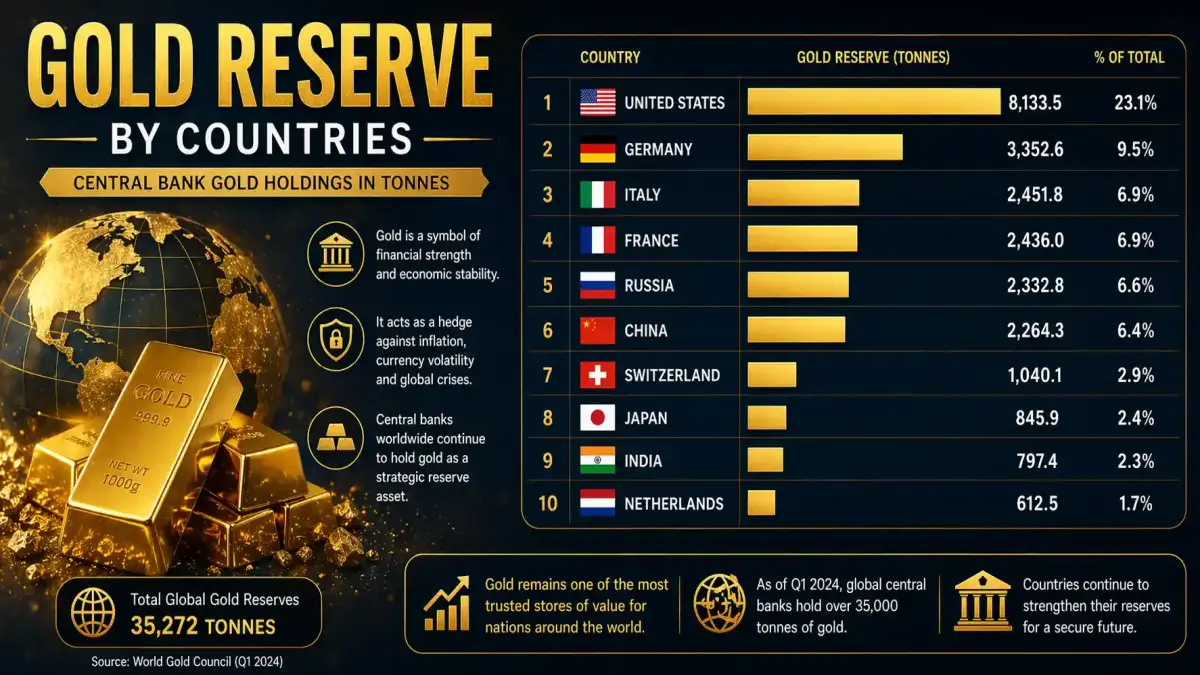
Gold Reserve by Countries
Table of Contents
Gold Reserve by Countries: Global Rankings, Importance and Economic Impact
What are gold reserves by countries?
Gold reserves are the amount of gold held by central banks and governments to support currency stability, economic security, and financial confidence.
Gold reserves represent one of the most important components of a nation’s financial strength. While modern economies rely heavily on digital transactions and fiat currencies, gold continues to serve as a reliable store of value and a safeguard against economic uncertainty. Countries around the world maintain gold reserves as part of their central bank holdings, ensuring stability in times of crisis and strengthening confidence in their monetary systems.
Understanding gold reserves by countries is essential for anyone interested in global economics, financial markets, or long-term investment strategies. These reserves influence currency value, trade balance, and investor sentiment. They also reflect how governments prepare for economic challenges and manage financial risks.
What Are Gold Reserves?
Gold reserves are physical gold assets held by central banks or governments as part of their foreign exchange reserves. These reserves are typically stored in secure vaults and are used to back national currencies, stabilize financial systems, and provide liquidity during economic crises.
Unlike other assets, gold is not tied to any specific currency or economy. This makes it a universal asset that can retain value even when financial systems face instability. Because of this unique characteristic, gold reserves play a critical role in maintaining economic confidence.
Why Countries Hold Gold Reserves
Countries hold gold reserves for several important reasons. One of the primary reasons is financial security. Gold acts as a hedge against inflation and currency devaluation, providing stability during uncertain times.
Another key reason is diversification. Central banks hold a mix of assets, including foreign currencies and bonds. Adding gold to this mix reduces risk and strengthens the overall financial position.
Gold also plays a role in maintaining investor confidence. When a country has strong gold reserves, it signals financial strength and stability, attracting investment and supporting economic growth.
Top Countries with the Largest Gold Reserves
United States
The United States holds the largest gold reserves in the world. These reserves are stored in highly secure locations such as Fort Knox. The large reserve provides strong backing for the US financial system and enhances global confidence in the US dollar.
The US has maintained its position for decades, reflecting its economic strength and strategic financial policies.
Germany
Germany has one of the largest gold reserves globally. The country views gold as a key component of its financial security and has taken steps to store a significant portion domestically.
Germany’s gold reserves provide stability and support its strong economic position within Europe.
Italy
Italy holds substantial gold reserves, which play a crucial role in supporting its financial system. Despite economic challenges, these reserves provide a strong safety net.
Gold reserves help maintain confidence in Italy’s economy and financial stability.
France
France is another major holder of gold reserves. The country maintains a balanced approach to reserve management, using gold as a key component of its financial strategy.
These reserves contribute to France’s economic resilience and stability.
Russia
Russia has significantly increased its gold reserves in recent years. The country uses gold to reduce reliance on foreign currencies and strengthen its financial independence.
This strategy has made Russia one of the fastest-growing gold reserve holders globally.
China
China continues to expand its gold reserves as part of its long-term economic strategy. The country views gold as a way to diversify its reserves and reduce dependence on the US dollar.
China’s growing reserves reflect its rising influence in global financial markets.
Other Countries with Notable Gold Reserves
In addition to the top holders, several other countries maintain significant gold reserves. These include Switzerland, India, Japan, and the Netherlands. While their reserves may not be as large, they still play an important role in supporting economic stability.
These countries use gold reserves as part of a broader financial strategy, balancing risk and ensuring long-term security.
How Gold Reserves Affect the Economy
Gold reserves have a direct impact on a country’s economy. They help stabilize currency value by providing a reliable backing. During times of economic uncertainty, gold reserves can be used to support financial systems and maintain liquidity.
Strong reserves also improve investor confidence, attracting foreign investment and supporting economic growth. This makes gold reserves a critical component of national financial strategy.
Gold Reserves vs Foreign Exchange Reserves
Gold reserves are often compared to foreign exchange reserves, which include currencies and bonds. While both are important, gold offers unique advantages because it is not tied to any specific economy.
This independence makes gold a valuable asset for diversification and risk management.
Trends in Global Gold Reserves
In recent years, many countries have increased their gold reserves. This trend reflects growing concerns about economic uncertainty and currency fluctuations.
Central banks are recognizing the importance of gold as a stable and reliable asset, leading to increased demand and accumulation.
Challenges in Managing Gold Reserves
Managing gold reserves involves several challenges, including storage costs, security, and market fluctuations. Governments must ensure that their reserves are safely stored and efficiently managed.
Despite these challenges, the benefits of holding gold reserves outweigh the risks, making it a key component of financial strategy.
Future Outlook of Gold Reserves
The importance of gold reserves is expected to grow in the future. As global economic uncertainty continues, countries are likely to increase their holdings to strengthen financial stability.
Technological advancements and changes in global trade may also influence how gold reserves are managed and utilized.
Why Gold Reserves Matter for Investors
For investors, understanding gold reserves provides valuable insights into global financial trends. Countries with strong reserves are better positioned to handle economic challenges, which can influence investment decisions.
Gold reserves also affect gold prices, making them an important factor in market analysis.
Conclusion
Gold reserves by countries play a vital role in the global financial system. They provide stability, support currency value, and enhance investor confidence. From the United States to emerging economies, gold remains a key asset in national financial strategies.
By understanding how gold reserves work and which countries hold the most, investors and individuals can gain deeper insights into global markets and make informed financial decisions.







0 Comments