
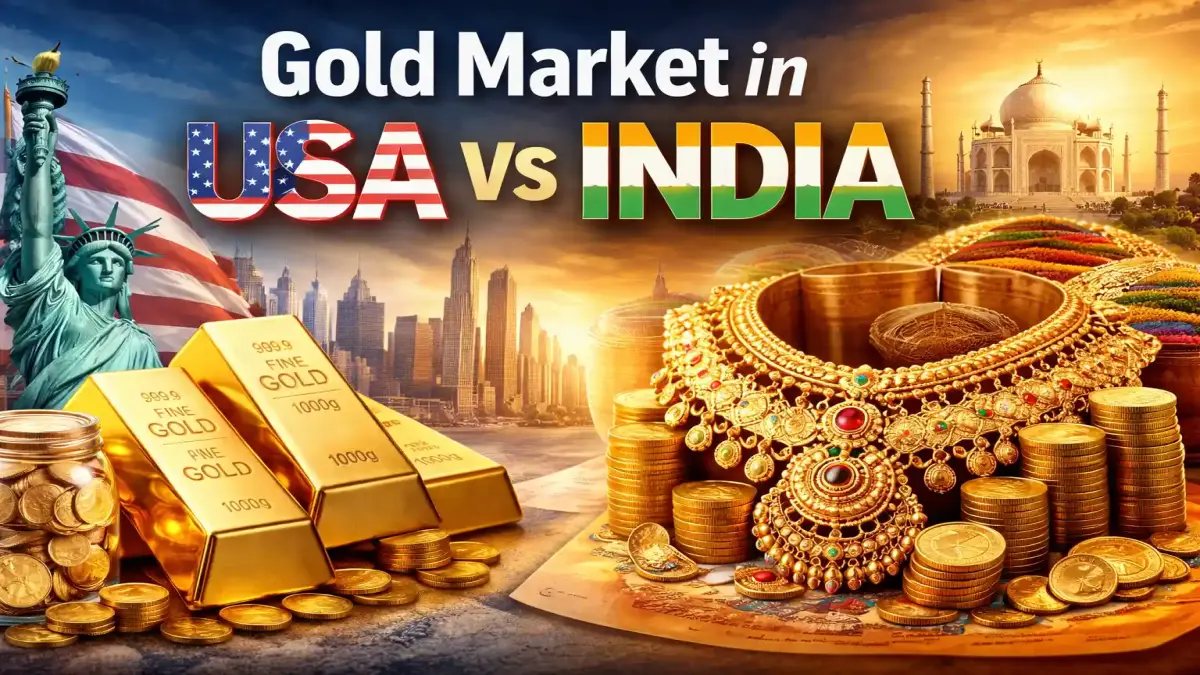
Gold Market in USA vs India
Table of Contents
Gold Market in USA vs India: A Complete Comparison for Smart Investors
Gold is one of the most universally valued assets in the world, yet the way it is perceived, purchased, and invested in varies significantly from country to country. Among all global markets, the United States and India stand out as two of the most influential players, but for entirely different reasons. While the United States dominates in terms of financial innovation and institutional investment, India leads in physical demand driven by culture, tradition, and household savings behavior.
Understanding the differences between these two markets is essential for anyone looking to invest in gold strategically. This comparison goes beyond simple price differences and explores deeper aspects such as demand patterns, investment methods, taxation, and economic impact.
Cultural vs Financial Perspective of Gold
In India, gold is deeply rooted in culture and tradition. It is not just an investment but a symbol of wealth, prosperity, and security. Gold is commonly purchased during festivals, weddings, and religious ceremonies. Families often pass gold down through generations, making it both an emotional and financial asset.
In contrast, the United States views gold primarily as a financial instrument. Investors in the US typically buy gold to hedge against inflation, diversify portfolios, or protect against economic uncertainty. Physical gold is less common, and most investments are made through financial products such as ETFs and futures contracts.
Demand Structure in USA vs India
India is one of the largest consumers of physical gold in the world. Demand is largely driven by jewelry purchases and rural savings. Even in times of economic difficulty, gold remains a preferred store of value for Indian households.
In the United States, demand is driven more by institutional investors and financial markets. Gold demand increases during economic uncertainty, stock market volatility, or inflation concerns. Retail investors also participate, but through digital platforms rather than physical purchases.
Gold Pricing Mechanism
Gold prices in both countries are influenced by international markets, but local factors create differences. In the United States, gold prices closely follow global spot prices with minimal additional costs.
In India, gold prices are significantly affected by import duties, taxes, currency exchange rates, and local demand. As a result, gold is often more expensive in India compared to the global market.
Investment Options Available
The United States offers a wide range of gold investment options, including ETFs, mining stocks, futures, and options. These instruments provide high liquidity and flexibility, making it easy for investors to enter and exit positions.
India, while traditionally focused on physical gold, has seen a rise in modern investment options such as digital gold, gold ETFs, and sovereign gold bonds. These options are gradually changing how Indians invest in gold, offering better efficiency and transparency.
Taxation Differences
Taxation plays a significant role in investment decisions. In the United States, gold is considered a collectible asset and is taxed accordingly when sold for profit. This can result in higher tax rates compared to other investments.
In India, gold taxation depends on the holding period. Short-term gains are taxed differently from long-term gains, and there are additional considerations such as GST on purchases. These factors can influence the overall return on investment.
Role of Gold in Economic Stability
Gold plays a different role in the economies of the two countries. In India, gold is a major component of household wealth and acts as a financial safety net. During emergencies, families often rely on gold loans to meet financial needs.
In the United States, gold is more closely linked to financial markets and macroeconomic indicators. It is used as a hedge against inflation and currency fluctuations rather than a primary savings tool.
Liquidity and Accessibility
Liquidity refers to how easily an asset can be converted into cash. In the United States, gold investments are highly liquid due to well-developed financial markets. Investors can quickly buy or sell gold through online platforms.
In India, physical gold is also highly liquid, but selling it may involve negotiation and price differences. However, modern financial products are improving liquidity and making transactions more efficient.
Risk Factors in Both Markets
Both markets have their own risks. In the United States, gold prices can be influenced by interest rate changes and monetary policies. In India, risks include price volatility, storage concerns, and making charges associated with jewelry.
Understanding these risks is crucial for making informed investment decisions.
Future Trends in Gold Markets
The gold market is evolving in both countries. In the United States, technological advancements and financial innovation are making gold investment more accessible. In India, digital transformation is gradually shifting demand from physical gold to financial products.
These trends indicate that while the fundamental value of gold remains unchanged, the way people invest in it is continuously evolving.
Which Market is Better for Investors?
There is no single answer to this question. The best market depends on your investment goals, risk tolerance, and financial strategy. If you prefer traditional and tangible assets, the Indian market offers familiarity and cultural relevance. If you prefer flexibility and financial instruments, the US market provides advanced options and liquidity.
A balanced approach that considers the strengths of both markets can be the most effective strategy.
Final Thoughts
The gold markets in the United States and India represent two different philosophies of investment. One is driven by tradition and physical ownership, while the other is shaped by financial innovation and market dynamics. Both have their advantages and challenges, and understanding these differences can help investors make smarter decisions.
Ultimately, gold remains a powerful asset regardless of geography. Its ability to preserve value and provide stability makes it an essential component of a diversified portfolio. By understanding how different markets operate, investors can take advantage of opportunities and build a stronger financial future.







0 Comments