
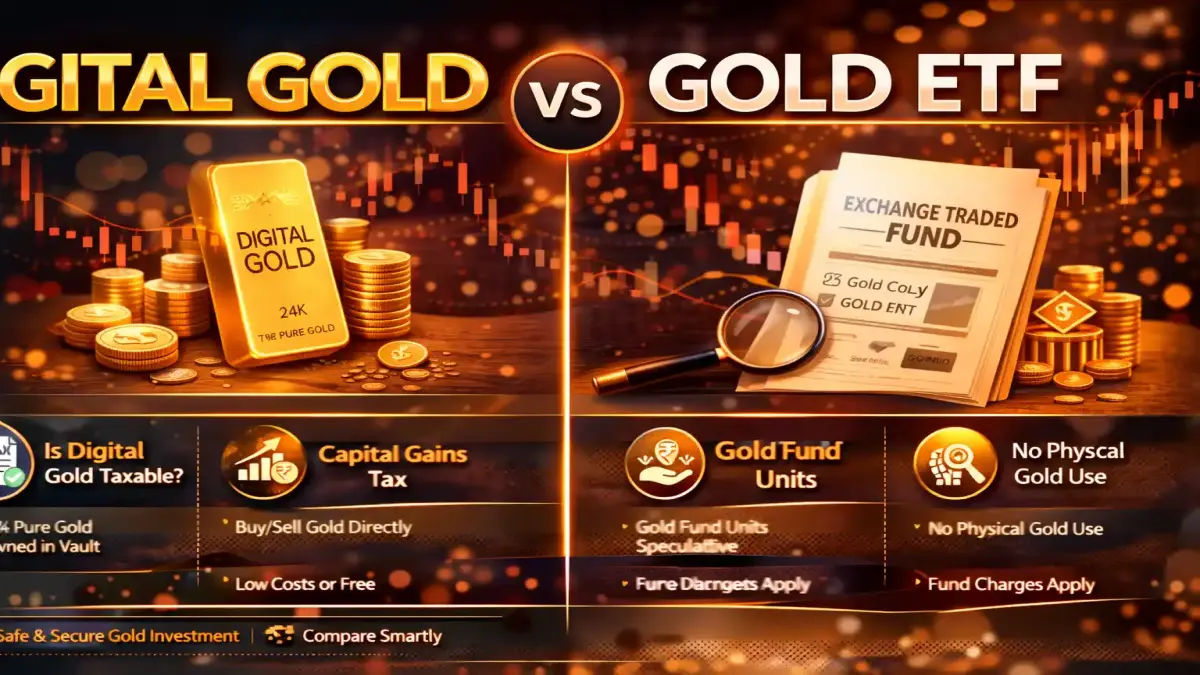
Digital Gold vs Gold ETF
Table of Contents
Digital Gold vs Gold ETF: Which is the Better Investment Option?
Quick Answer (Featured Snippet)
Digital gold is ideal for small, flexible investments with easy access, while Gold ETFs are better for regulated, long-term investing through stock markets. If you want convenience, choose digital gold. If you want safety and transparency, choose Gold ETF.
Introduction
Gold has always been one of the most trusted investment options in India. With the rise of technology and financial innovation, investors now have multiple ways to invest in gold without physically holding it. Two of the most popular options today are digital gold and gold exchange-traded funds (ETFs).
While both options allow investors to benefit from gold price appreciation, they differ significantly in terms of structure, safety, taxation, liquidity, and overall investment strategy. Many investors are confused about which option suits their needs better.
This guide provides a complete comparison between digital gold and gold ETFs. By the end of this article, you will clearly understand which investment option is more suitable based on your financial goals, risk tolerance, and investment horizon.
What is Digital Gold?
Digital gold is an online method of buying physical gold in small quantities. It allows investors to purchase gold starting from very low amounts. The gold purchased is stored securely by the provider in insured vaults.
Investors can buy and sell digital gold anytime using mobile apps or websites. The biggest advantage of digital gold is its accessibility and ease of use, especially for beginners.
What is Gold ETF?
A Gold ETF is a type of mutual fund that invests in gold and is traded on stock exchanges like shares. Each unit represents a certain quantity of gold. Investors need a demat account to buy and sell gold ETFs.
Gold ETFs are regulated by financial authorities and provide a more structured and transparent investment option compared to digital gold.
Key Differences Between Digital Gold and Gold ETF
1. Ownership Structure
In digital gold, investors own physical gold stored in vaults. In contrast, Gold ETFs represent ownership in a fund that tracks gold prices. Investors do not directly own physical gold in ETFs.
2. Accessibility
Digital gold is easily accessible through mobile apps and requires no special account. Gold ETFs require a demat and trading account, making them slightly more complex for beginners.
3. Regulation and Safety
Gold ETFs are regulated by market authorities, ensuring higher transparency and investor protection. Digital gold is offered by private companies and may not have the same level of regulation.
4. Liquidity
Both options offer good liquidity, but Gold ETFs depend on stock market trading hours, while digital gold can be traded anytime.
5. Investment Amount
Digital gold allows micro-investments, making it suitable for small investors. Gold ETFs usually require a minimum investment equivalent to one unit price.
Cost Comparison
Digital gold includes spread costs, storage fees, and GST. Gold ETFs include brokerage charges, expense ratios, and demat charges. Over time, ETFs may be more cost-efficient for long-term investors.
Taxation Differences
Both digital gold and Gold ETFs are taxed similarly. Short-term gains are taxed as per income slab, while long-term gains are taxed at 20% with indexation.
However, investors must maintain proper records for accurate tax calculation.
Real-Life Investment Scenario
Consider two investors. One invests small amounts monthly through digital gold, while the other invests a lump sum in Gold ETF. The first investor benefits from flexibility, while the second benefits from lower long-term costs and regulation.
The choice depends on individual financial goals and investment habits.
Advantages of Digital Gold
- Easy to start with small amounts
- No demat account required
- Instant buying and selling
- Convenient and beginner-friendly
Advantages of Gold ETF
- Regulated investment
- High transparency
- Lower long-term costs
- Suitable for serious investors
Disadvantages of Digital Gold
- Lack of strong regulation
- Higher costs over time
- Limited investment structure
Disadvantages of Gold ETF
- Requires demat account
- Brokerage charges
- Market timing required
Which One Should You Choose?
If you are a beginner looking for easy and flexible investment, digital gold is a good choice. If you are a long-term investor looking for regulated and cost-efficient investment, Gold ETF is the better option.
A balanced approach can also be used, where digital gold is used for short-term goals and Gold ETF for long-term wealth building.
Common Mistakes to Avoid
- Choosing based only on convenience
- Ignoring tax implications
- Not considering long-term costs
- Lack of diversification
Expert Tips
Investors should clearly define their goals before choosing between digital gold and Gold ETF. Diversification across different asset classes is also important for reducing risk.
Regular monitoring and disciplined investing can help achieve better financial outcomes.
FAQ Section
Is Digital Gold safe?
It is relatively safe but not as regulated as Gold ETFs.
Can I convert digital gold to physical gold?
Yes, most platforms allow conversion into physical gold.
Which is better for long-term investment?
Gold ETF is generally better for long-term due to regulation and lower costs.
Do Gold ETFs give better returns?
Returns depend on gold prices, but ETFs may provide better cost efficiency over time.
Conclusion
Both digital gold and Gold ETF have their own advantages and limitations. The right choice depends on your investment goals, risk tolerance, and financial knowledge.
Digital gold offers convenience and flexibility, while Gold ETFs provide structure and security. By understanding the differences and planning your investment strategy carefully, you can make smarter decisions and maximize your returns.






0 Comments